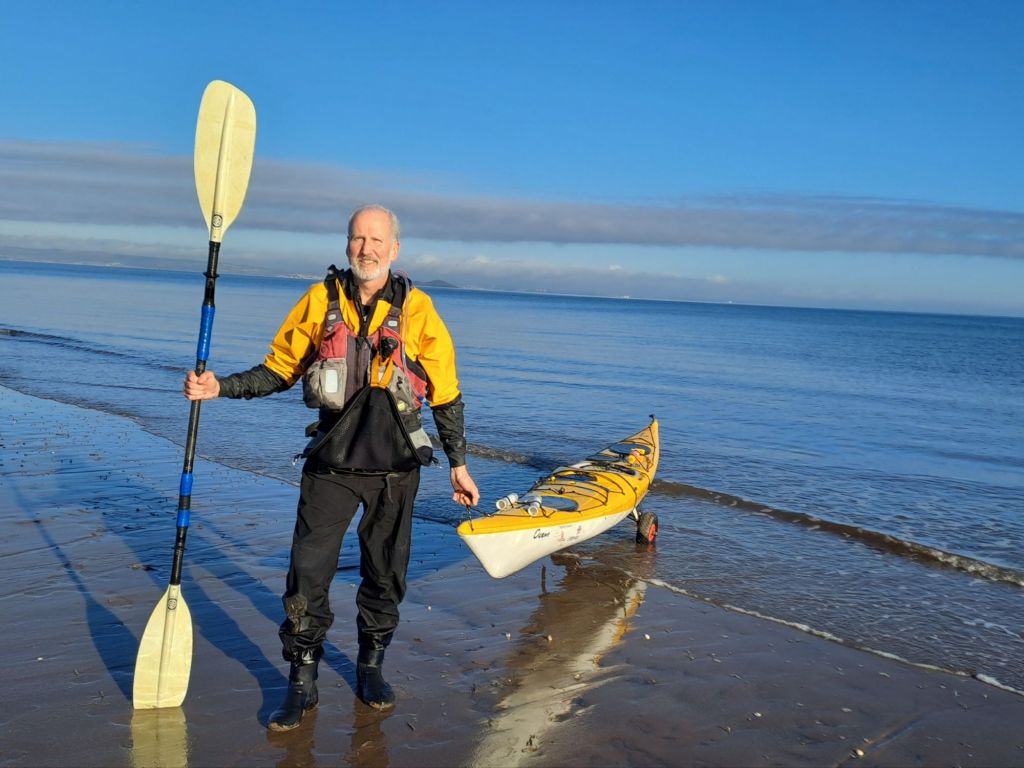
The boat is a 17′ sea kayak – a composite Northshore Ocean 17. I bought it new 12 years ago and it has served me well. It’s the third sea kayak I’ve owned. I started 18 years ago with a 16′ plastic Valley Avocet and soon progressed to a composite 16’6” Malin Gometra. The Gometra was a pretty good touring boat, but it has a few design idiosyncrasies that can make it a little temperamental to live with on a long trip: only two bulkheads, no rocker, and hatch covers that can prove difficult to get a good waterproof seal on at times. I still have the Gometra, but it hasn’t been on the water for several years. Getting it shipshape again is a project for another year.
My current Northshore Ocean has been on many trips, including successful circumnavigations of Mull, Skye, Jura, Islay, and Ireland.
Before the Ireland trip of 2019 I fitted an electric pump, a keel strip, and further protector strips in the cockpit to minimise wear caused by heels rubbing on the hull. These are all still in place and working as designed. The keel strip looks as though it has encountered the odd barnacled rock or two, but it should be good for a few more trips.
The rudder I bought for the Ireland trip never got fitted then and still remains in its box. It’s not that I’m against rudders, I think it’s more an aversion to drilling holes in and sawing bits off an old friend. Maybe my next boat will come pre-fitted with a rudder.
The Kit
(A work in progress. I’ll probably add to this when I can think of nothing else to do on a windy beach bound day.)
Tent
I have tried three different tents on my kayak trips. I have a Lightwave T2 tunnel tent with extended porch that dates from before my sea kayaking days. It was originally purchased for 2-person back packing trips. It’s a robust, lightweight tent that has served me well for most of my trips. There is always a load more stuff to deal with when kayaking compared to backpacking, so a 2-man tent is worth the extra weight – the extended porch helps greatly when cooped up for a few days of bad weather and you need to cook (carefully) without going out.
On a trip round Islay with James and Fiona, I decided to try a more minimalist approach and went with a 1-man Laser Competition Pro. It worked, but it certainly wasn’t a trip where I’d be retiring to my bed early. It was claustrophobic and had nowhere to put anything inside the tent. I definitely require a bit more space to properly enjoy the camping experience.
Although the Lightwave is a good tent there are a couple of things that have irritated me about it over the years. It’s a three hoop tunnel that requires quite a bit of flat ground space if it’s going to pitch securely with all its guy ropes out. That’s not something you can always arrange when camping on a rough Scottish coastline. Even when you do have a good pitch, it can be tricky to get everything tensioned nicely so that some part of the fly isn’t a little slack. A slack fly in a strong wind can be a very noisy bed companion.
For the long Ireland trip I decided it was time to review my tent options. The MSR Elixir 2 that I ended up with has not disappointed. It was very reasonably priced (just £200 at the time) and has performed far better than tents considerably more expensive. David and I independently assessed tents at that time and both ended up making the same decision (I’m sure it wasn’t only because we’re both penny pinching Scots). The tent is easy to pitch, with only two long poles and a short cross pole at the top. It is symmetrical with a door on either side and can be moved easily after pitching without dismantling. The porches on either side are not large but you can still stash a load of stuff in one when you’re not using it as a door. It has enough room inside so that you can sit up (using a Thermarest folding seat) without your head pushing the inner against the fly. It proved secure on grass, sand, and pebbles – though thankfully those pitches were a last resort and infrequent.
Paul – a man with a van and more tents than an army platoon – has the more expensive MSR Hubba Hubba 2 (when it’s not being trampled on by wild horses in the Pyrenees). It is lighter and well suited to backpacking. Once pitched they look very similar and have the same amount of space inside. However, it is considerably trickier to pitch in a wind and feels less robust. I think the Elixir is probably a better tent for sea-kayaking where weight is less of an issue and windy pitches are assured.
Camping mattress and sleeping bag
There’s little to be said about a sleeping bag, but plenty more to say about the mattress. I have a medium weight Rab down filled bag that has served me well for many years. I’m seldom kayaking in sub-zero temperatures, so it’s more a case of getting something that is warm enough without taking up too much space when in its stuff sack.
Camping mattresses – mat (closed-cell, self-inflating) or pad (inflation) – have come and gone quite regularly. The one I have for this trip is a Nemo Tensor Trail Ultralight pad. I’ve only used it a couple of times. It’s comfortable and has stayed reliably inflated so far. Is it robust? Only time will tell.
This is my second pad. Their big advantage is that they pack down much smaller and are generally lighter and warmer too. The Nemo one rolls up into a bag not much bigger than a 1 litre drinking bottle but inflates to a full size mattress that is 10cm thick. The one I had before this, and took to Ireland, was a Therm-a-Rest Ultralight with a wide neck that was supposed to make for easy inflation… it didn’t. Not only did it not work for inflation, it was also rather good at self-deflation. Before taking it on the Ireland trip I had already given up on the wide neck and had used a hot iron to seal it up and cut off the extra material. This meant I had to inflate it using the small mouth piece. An exercise that takes about five minutes and leaves you light headed. Even without the wide neck I soon started to experience further deflations and was waking up a couple of times during the night to top it up. I have found and patched the leaks a couple of times since, but as they are in the fold of material by the valve I have little faith in them staying fixed. Hence the purchase of the Nemo pad.
I still have a full-size Therm-a-Rest mat dating from the 90s and a couple of three quarter size thinner ones that have never given me any problems. I have used them on kayak trips but the full-size one takes up considerable space and can’t really be justified on a trip longer than a couple of days. I sometimes take one of the shorter ones to be used in a Therm-a-Rest folding seat. Inflatable pads are useless for this purpose. Whether or not it makes it on this trip will be decided at the later stages of packing.
 One Man And His Boat